Checking electrolytic capacitors by ESR: why and how to read the result
A bulged electrolytic capacitor is easy to spot. The harder case is a capacitor that looks fine, has normal capacitance, and yet the power supply works erratically. ESR helps here.
What ESR is
ESR is the equivalent series resistance of a capacitor. As the electrolyte ages and “dries”, ESR grows while capacitance may barely change. The power supply and backlight then run hot, protection trips, and the TV clicks or does not start.
How to measure
- It is better to measure a capacitor desoldered, or at least discharged. In circuit, other parts can distort the reading.
- Use an ESR meter or an LCR meter at a suitable frequency.
- Compare with the norm for your capacitance and voltage. Low-impedance (Low-ESR) series have a noticeably lower value than ordinary ones.
How to read the result
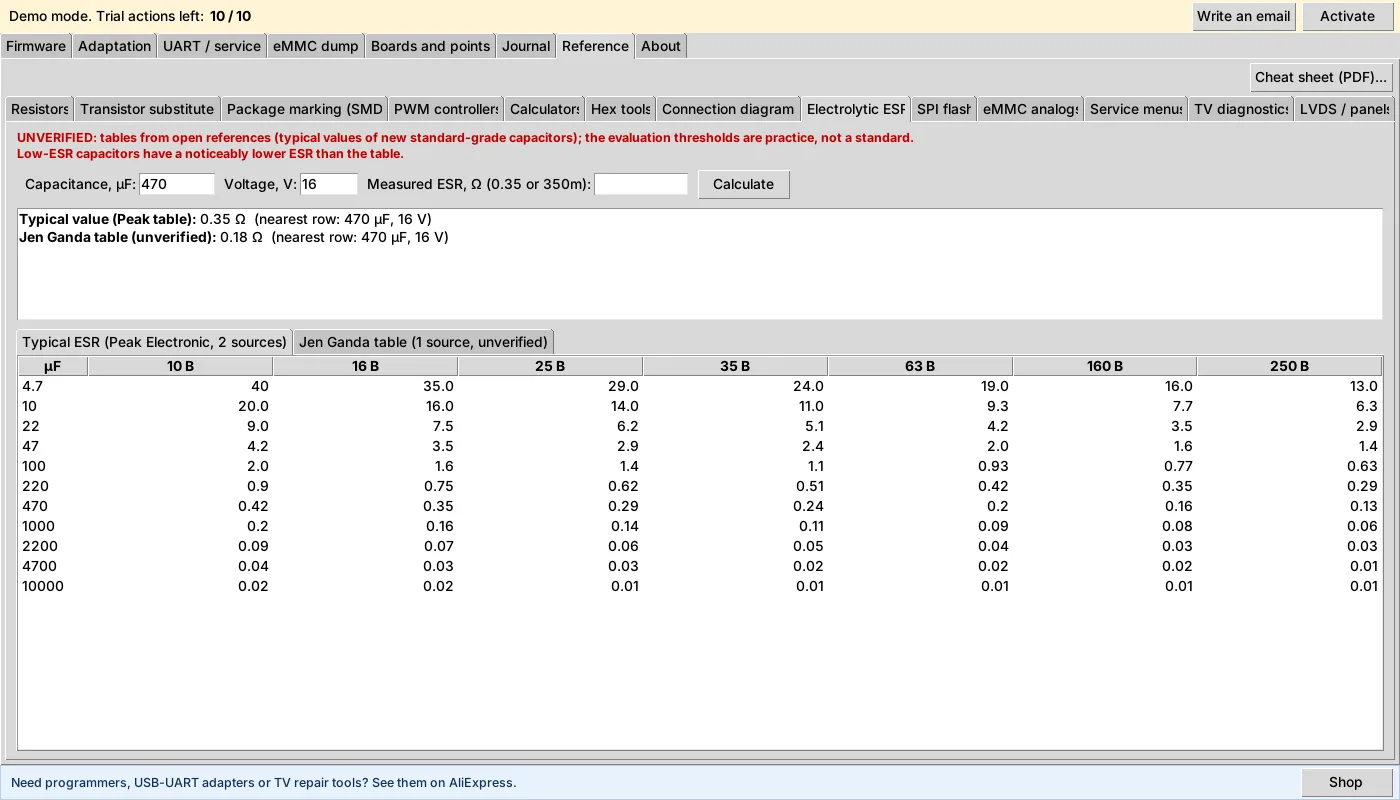
The FW Tool reference has a table of typical ESR values by capacitance and voltage and an evaluation calculator: enter capacitance, voltage and the measured value, and the program compares it with the table. In practice it is common to treat up to 1.5× the norm as fine, up to 3× as elevated (keep an eye on it), and above that as a replace.
UNVERIFIED The tables are taken from open sources (typical values of new standard-grade capacitors) and the evaluation thresholds are practice, not a standard. For critical circuits check the datasheet of the specific series.
Practical advice
If one capacitor in a group is bad, the others from the same batch are usually close to it. It is better to replace the whole set in the circuit, especially in the power supply output stages and in the backlight.